
Ancient Arabian Trade Routes – From Incense to Silk
About this Document
Document Content
Introduction:
Trade routes played a major role in shaping the history of the ancient world, and the Arabian region stood at the center of these networks that connected Eastern and Western civilizations. These routes were not just paths for transporting goods, but also channels for exchanging ideas, cultures, and religions.
The Arabian Peninsula emerged as a key corridor for global trade, especially for incense and spices coming from the south of the peninsula, as well as silk arriving from the Far East. This gave Arabs a strong economic and strategic position in the ancient world.
1. Trade Routes in the Arabian Peninsula:
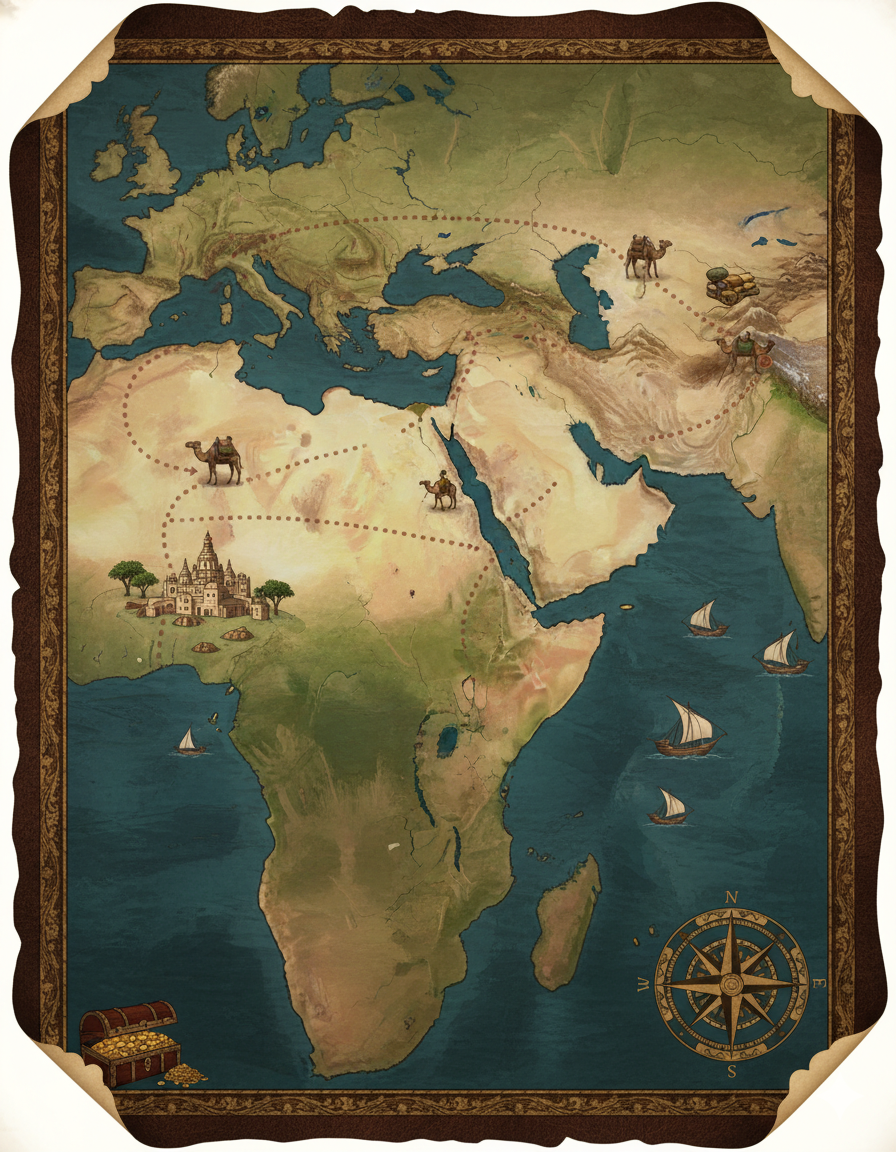
Several trade routes passed through the Arabian Peninsula, the most important of which were:
Incense Route:
It stretched from the southern Arabian Peninsula (Yemen and Oman) through the Hijaz region, reaching the Levant and Egypt. It was used to transport frankincense and myrrh, which were highly valued in ancient religious rituals.
Maritime Route:
This relied on Arabian ports on the Red Sea and the Arabian Gulf, where ships carried goods between India, East Africa, and the Arabian Peninsula.
Silk Route:
Although its core was in Asia, Arabs played a major intermediary role in transporting silk to Western markets.
2. Importance of Incense and Spice Trade:
The incense trade was one of the main sources of wealth in southern Arabia, especially in kingdoms like Saba and Hadramawt. It was closely linked to religious practices in ancient civilizations, which increased its economic value.
Spices coming from India and Southeast Asia were also highly strategic goods, used in food and medicine, and were in great demand in European markets.
3. Arabs as Trade Intermediaries:
Arabs were known for their ability to manage trade networks efficiently. They acted as intermediaries between different civilizations. Their role was not limited to transportation only, but also included redistributing goods and organizing markets.
This contributed to the prosperity of commercial cities such as Mecca and Yathrib, which became major centers of trade exchange.
4. Cultural and Civilizational Impact:
The impact of these trade routes was not limited to the economy; it extended to cultural and civilizational aspects, including:
- The transfer of languages and ideas
- The spread of religions
- The exchange of customs and traditions among peoples
5. Decline of Land Trade Routes:
With the development of maritime navigation and the discovery of new sea routes, the importance of land routes gradually declined. Political changes in the region also contributed to weakening these networks.
6. Conclusion:
Ancient Arabian trade routes represent an early model of globalization, as they helped connect civilizations and exchange resources and cultures. Arabs played a central role in these networks, which strengthened their economic and civilizational status throughout history.