
Tribes of the Arabian Peninsula Before Islam – The Social and Political Landscape
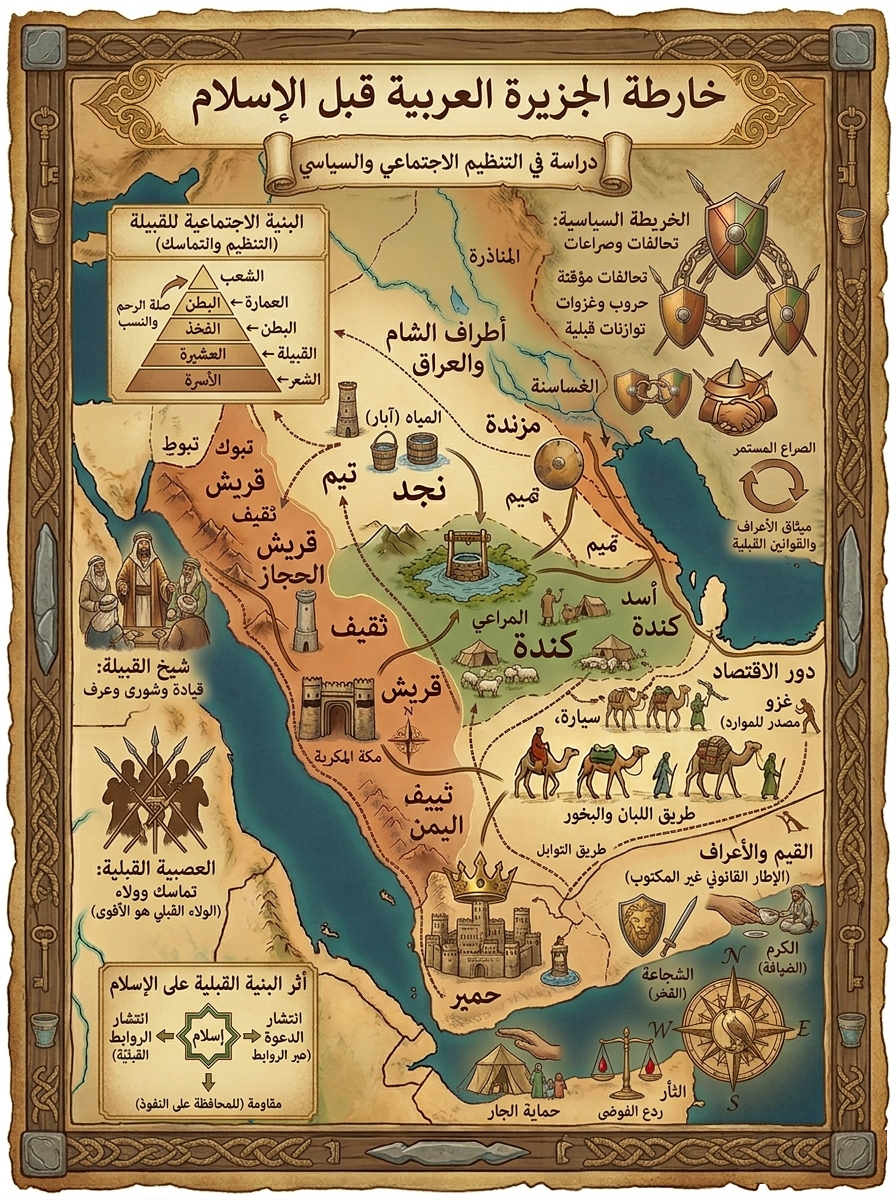
About this Document
Document Content
Introduction:
Before the rise of Islam, the Arabian Peninsula was a predominantly tribal society, where the tribe formed the basic unit of social and political organization. Individuals relied entirely on their tribal affiliation to determine their status, protection, and relationships with others.
In the absence of a central state, complex patterns of alliances and conflicts emerged among tribes, resulting in a politically unstable map, yet one that was regulated by established tribal customs and traditions.
1. Social Structure of the Tribe:
The tribe consisted of a group of individuals connected by lineage or alliances. Each tribe was led by a (tribal chief) who governed based on consultation and customary laws.
Tribal solidarity (asabiyyah) played a key role in strengthening internal cohesion, with loyalty to the tribe taking precedence over any other affiliation.
2. Geographic Distribution of Tribes:
Arab tribes were spread across different regions of the Arabian Peninsula, including:
• Hijaz
• Najd
• Yemen
• The outskirts of the Levant and Iraq
This distribution was influenced by factors such as water availability, grazing lands, and trade routes.
3. Political Landscape: Alliances and Conflicts:
There was no central authority; instead, relations between tribes were based on:
• Temporary alliances
• Wars and raids
• Tribal balances of power
These factors led to ongoing conflicts, though they were governed by customs that limited chaos.
4. The Role of Economy in Tribal Relations:
Tribes relied on various economic activities, such as:
• Pastoralism
• Trade
• Raiding (as a source of resources)
Trade routes played a significant role in increasing the influence of certain tribes, especially those controlling key routes.
5. Tribal Values and Customs:
The tribal society was characterized by a set of values that regulated relationships, such as:
• Generosity
• Courage
• Protection of neighbors
• Revenge
These values formed an unwritten but binding legal framework.
6. Impact of Tribal Structure on the Rise of Islam:
The tribal environment was both a challenge and an opportunity for the emergence of Islam. Tribal ties helped spread the message, but at the same time, they led some tribes to resist it.
Conclusion:
The social and political map of the Arabian Peninsula before Islam reflects a society based on tribal affiliation and decentralized balances of power. Understanding this structure helps explain many of the transformations that occurred with the rise of Islam, as society gradually shifted from tribal loyalty toward a more unified and organized system.