
The Islamic Conquest of Egypt – Events and Transformations
About this Document
Document Content
Introduction:
The Islamic conquest of Egypt is considered one of the most significant historical transformations in the region, marking a transition from Byzantine rule to incorporation into the emerging Islamic state. This shift was not merely political, but extended to deep social, economic, and cultural dimensions.
This phase came within the context of the expansion of the Islamic state beyond the Arabian Peninsula, with Egypt representing a strategically important location in terms of geography and resources.
1. Historical Context Before the Conquest:
Before the arrival of (Muslims), Egypt was under Byzantine rule, which faced several internal and external challenges:
• Weak central control
• Discontent among the local population
• Religious conflicts between different sects
These factors contributed to creating a favorable environment for major political change.
2. Beginning of the Islamic Conquest:
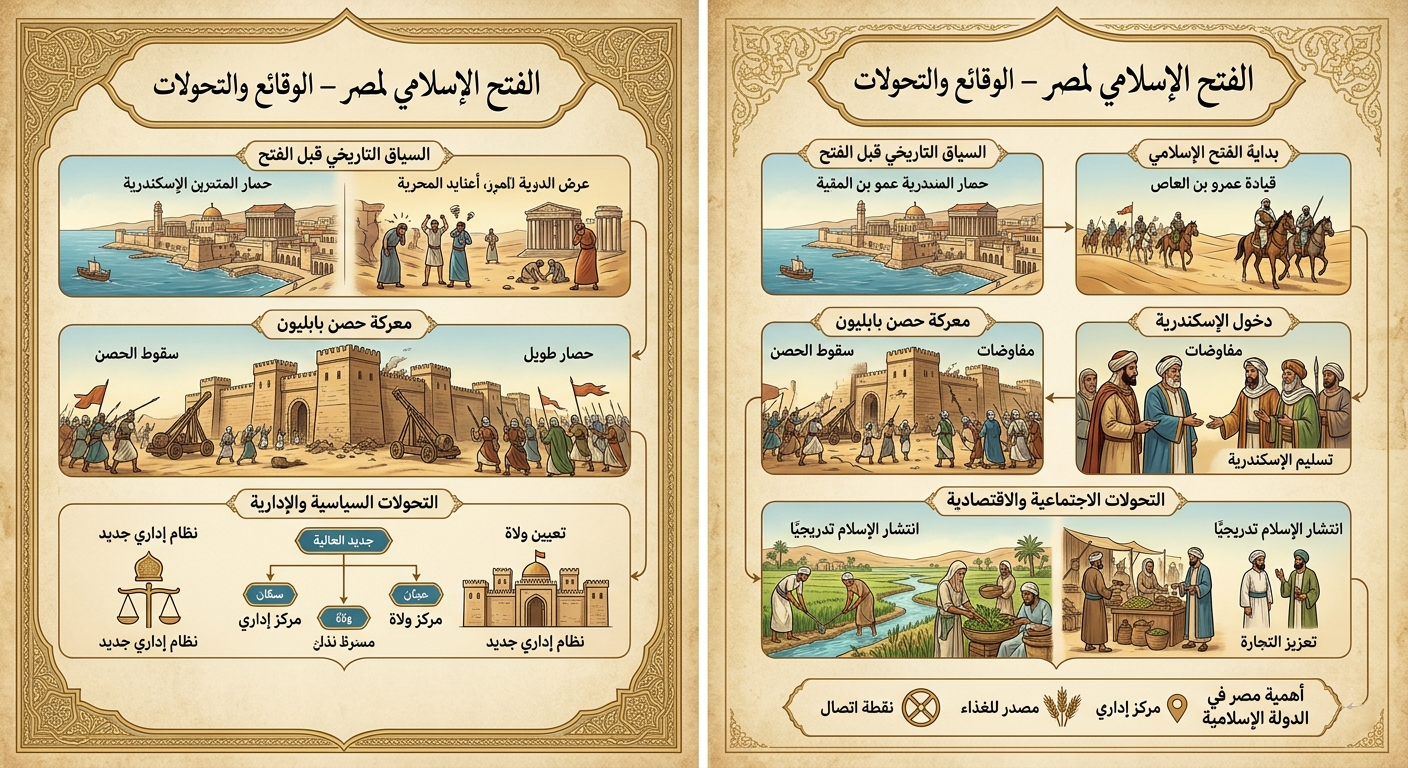
The conquest began under the leadership of Amr ibn al-As, who led a military campaign toward Egypt during the reign of Caliph Umar ibn al-Khattab.
• The campaign started from Palestine
• Advance toward the Fortress of Babylon
• Reliance on rapid movement and military tactics
Despite facing resistance, Muslim forces managed to make gradual progress.
3. Battle of the Fortress of Babylon:
This was one of the most important stages of the conquest, marking a decisive turning point in gaining control over Egypt.
• A prolonged siege lasting several months
• Strong Byzantine resistance
• Ended with Muslim control of the fortress
The fall of the fortress opened the way to the rest of Egypt.
4. Entry into Alexandria:
Alexandria was a major political and cultural center, and its fall was a pivotal moment.
• Negotiations between both sides
• Signing of surrender agreements
• Gradual transfer of control
Thus, Egypt came under Islamic rule.
5. Political Transformations:
The conquest led to clear changes in the political system:
• End of Byzantine rule
• Introduction of a new administrative system
• Appointment of governors to manage the country
This contributed to reorganizing authority within Egypt.
6. Social and Religious Transformations:
Changes were not immediate or radical, but rather gradual:
• Continuation of some local customs
• Gradual spread of Islam
• Coexistence between different religions
7. Economic Transformations:
Egypt witnessed changes in its economic system:
• Reorganization of taxation
• Preservation of agricultural activity
• Promotion of trade
Egypt’s strategic location helped support the economy of the Islamic state.
8. Importance of Egypt in the Islamic State:
After the conquest, Egypt became a key element within the state:
• An important administrative center
• A major source of food (especially grains)
• A link between East and West
Conclusion:
The Islamic conquest of Egypt represented a profound historical transformation that went beyond the military aspect, reshaping the political, social, and economic structure of the country. This transformation integrated Egypt into a new civilizational sphere that continued to influence its historical trajectory for centuries.