
Palestine
The Palestinian Cause – Historical Roots and Developments
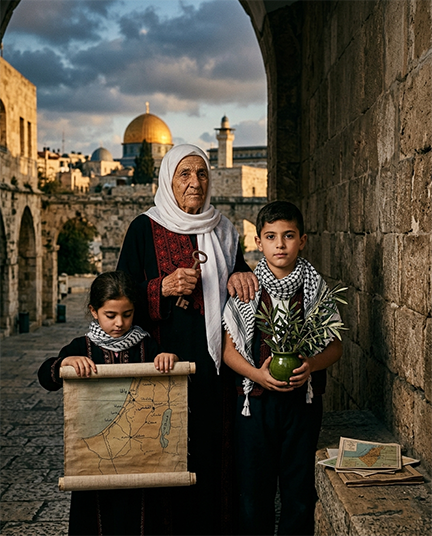
About this Document
Document Content
Introduction:
The Palestinian issue is considered one of the most prominent political and historical issues in the modern world. Since its beginnings, it has been closely linked to the struggle over land, identity, and sovereignty, eventually becoming a central in regional and international politics.
Palestine has witnessed a series of major transformations throughout its modern history, beginning with the decline of the Ottoman Empire, followed by the British Mandate, the emergence of the Zionist movement, and eventually the establishment of the State of Israel, which was followed by wars, conflicts, and the large-scale displacement of Palestinians.
The Palestinian issue has not remained merely a local conflict; rather, it evolved into an Arab and international issue with complex political, religious, and humanitarian dimensions that directly influenced the nature of relations in the Middle East for decades.
Despite more than a century having passed since the beginning of the conflict, the Palestinian issue continues to hold a central place in global politics amid ongoing disputes over the future of Palestinian territories and the rights of the Palestinian people.
1. Palestine Before the Modern Occupation:
• Historical and Geographical Importance of Palestine:
Palestine represents a region of major strategic and religious importance, located at a crossroads connecting Asia and Africa, while also containing some of the holiest sites of the Abrahamic religions.
• Palestine During the Ottoman Era:
Palestine remained part of the Ottoman Empire for several centuries. During this period, it was characterized by a religiously and culturally diverse society with a clear Arab majority.
• Demographic Structure Before the Twentieth Century:
Before the beginnings of the Zionist project, Palestine had a broad Arab presence in cities and villages, with economic life based mainly on agriculture, trade, and traditional crafts.
2. The Emergence of Zionism and the Beginnings of the Settlement Project:
• The Rise of the Zionist Movement:
The Zionist movement emerged in Europe during the late nineteenth century and called for the establishment of a national homeland for Jews in Palestine, benefiting from the rise of European nationalist movements.
• Jewish Immigration to Palestine:
Waves of Jewish immigration to Palestine began with the support of international institutions and organizations, leading to gradual demographic changes.
• Land Purchases and Settlement Expansion:
Zionist institutions worked to purchase land and establish settlements, creating growing tensions with the Arab Palestinian population.
3. The British Mandate and the Balfour Declaration:
• The Fall of the Ottoman Empire:
After World War I, Palestine came under British Mandate rule as part of the postwar regional arrangements.
• The Balfour Declaration of 1917:
Britain announced its support for the establishment of a national homeland for Jews in Palestine, which Palestinians and Arabs viewed as a direct threat to their national rights.
• Escalating Tensions:
British support for Jewish immigration led to repeated confrontations and protests involving Palestinians, British forces, and Zionist groups.
4. Palestinian Resistance During the Mandate Period:
• Popular Revolts and Protests:
Palestine witnessed several uprisings and revolts against British policies and settlement expansion, most notably the Great Palestinian Revolt between 1936 and 1939.
• Emergence of National Leaderships:
A number of Palestinian political figures and movements emerged to lead the national struggle during this period.
• Military and Political Challenges:
Palestinians faced major difficulties due to limited capabilities and internal divisions, while the Zionist movement received increasing international support.
5. The Partition Plan and the 1948 War:
• The Partition Plan:
In 1947, the United Nations issued a resolution to divide Palestine into Arab and Jewish states, a proposal rejected by Arabs and Palestinians.
• The Declaration of Israel:
In 1948, the State of Israel was declared, leading to the outbreak of the first Arab-Israeli war.
• The Palestinian Nakba:
The war resulted in the displacement of hundreds of thousands of Palestinians from their lands, turning them into refugees inside and outside Palestine.
6. The Palestinian Issue After the Nakba:
• The Emergence of Palestinian Refugee Camps:
Palestinian refugees settled in camps across neighboring Arab countries, making the refugee issue one of the central aspects of the conflict.
• The Beginning of Armed Resistance:
Palestinian armed organizations emerged seeking to resist occupation and recover Palestinian territories.
• The Establishment of the Palestine Liberation Organization:
The organization was established as the political representative of the Palestinian people.
7. Arab-Israeli Wars and Their Impact:
• The 1967 War:
The war led to Israel’s occupation of the West Bank, Gaza Strip, and East Jerusalem, fundamentally changing the nature of the conflict.
• The 1973 War:
This war represented an Arab attempt to recover occupied territories and influenced regional political balances.
• The Impact of Wars on Palestinians:
The wars contributed to increasing the complexity of the issue and deepening humanitarian and political crises.
8. The Palestinian Intifadas:
• The First Intifada (1987):
The Palestinian territories witnessed widespread protests against occupation, bringing the Palestinian issue back to the forefront of international attention.
• The Second Intifada:
It emerged amid the failure of the peace process and escalating tensions.
• The Role of Popular Resistance:
The intifadas demonstrated Palestinians’ ability to use multiple forms of resistance, both popular and armed.
9. Peace Agreements and Political Transformations:
• The Oslo Accords:
The 1990s witnessed the beginning of direct negotiations between Palestinians and Israelis, alongside the establishment of the Palestinian Authority.
• Challenges Facing the Peace Process:
The agreements faced major obstacles related to settlements, borders, Jerusalem, and refugees.
• Internal Palestinian Division:
Political divisions among Palestinian factions complicated the internal situation.
10. Jerusalem and Settlement Expansion:
• The Importance of Jerusalem:
Jerusalem represents a central aspect of the conflict because of its religious and political significance.
• Settlement Expansion:
Israel continued building settlements in Palestinian territories, affecting the prospects of establishing an independent Palestinian state.
• Demographic Changes:
Settlement policies contributed to changing the demographic and geographic realities in certain areas.
11. The Arab and International Dimensions of the Issue:
• Arab Support for the Palestinian Cause:
For many decades, the Palestinian issue remained a central focus of Arab politics.
• The International Role:
Various international powers intervened in managing the conflict through mediation efforts or political and military support.
• Changing Regional Positions:
The region witnessed transformations in alliances and relations that influenced the course of the issue.
12. Humanitarian and Economic Conditions:
• Blockade and Living Conditions:
Some Palestinian areas suffer from difficult humanitarian and economic conditions due to blockades and various restrictions.
• Unemployment and Poverty:
Ongoing political crises have negatively affected the Palestinian economy and development opportunities.
• Daily Challenges Facing Palestinians:
Residents face difficulties related to movement, employment, and access to basic services.
13. The Future of the Palestinian Issue:
• The Two-State Solution:
It continues to be proposed as one of the possible political solutions despite the major challenges facing it.
• The Continuation of the Conflict:
Some believe that the absence of a comprehensive settlement may lead to prolonged tensions.
• The Role of the International Community:
International positions remain a major factor influencing the future of the issue and possible paths toward resolution.
Conclusion:
The Palestinian issue represents one of the most complex and enduring issues in modern history, shaped by intertwined historical, political, religious, and humanitarian factors over more than a century. It has directly influenced the stability of the Middle East and international relations while becoming a central element in Arab political consciousness.
Despite the major transformations witnessed in the region and the world, the Palestinian issue continues to maintain its central importance amid the ongoing conflict over land, rights, and sovereignty. Its future remains closely tied to the ability of the different parties to reach a just and sustainable settlement.